Every SaaS company eventually hits the same wall: support volume grows faster than the internal team can keep up with, but the founders still want every high-value account handled with care. The fix isn’t hiring your way out of it — it’s building a tiered escalation model that clearly defines who owns what, so simple questions get answered fast and complex ones land in the right hands without delay.
Done well, a tiered support structure lets an outsourced partner absorb the bulk of routine tickets while your internal specialists focus on the accounts and issues that actually need their expertise. Done poorly, tickets bounce between teams, context gets lost, and your best customers feel like a number.
Today, Virtua will break down how to structure Tier 1, Tier 2, and Tier 3 ownership between an internal team and an outsourced partner, and give you a simple decision-tree framework to keep everything moving.
Why Escalation Structure Matters More Than Headcount
Most support breakdowns aren’t a staffing problem — they’re a routing problem. A few numbers make the case:
- Customer satisfaction drops by an average of 22 percentage points once a ticket is escalated, compared to issues resolved within the same tier. (Stealth Agents, Customer Support Escalation Statistics 2026)
- An escalated issue takes an average of 2.8 total contacts to resolve — nearly triple the effort of a first-contact resolution. (Stealth Agents, Customer Support Escalation Statistics 2026)
- Top-performing contact centers hit First Contact Resolution (FCR) rates of 74% or higher, while many teams treat 70% as the baseline benchmark. (Sprinklr; Which 50)
- For every 1% improvement in FCR, operating costs drop roughly 1% and customer satisfaction rises roughly 1%, according to SQM Group research. (Zendesk)
|
The takeaway: a well-designed tier structure isn’t just about ticket volume. It directly protects your margins and your renewal rate.
Structuring Tier 1, 2, and 3 Ownership
The most effective setups we’ve built at Virtua treat outsourcing as a genuine extension of the internal team, not a separate silo. Here’s how ownership typically splits:
Tier 1 — Outsourced Front Line
Handles high-volume, well-documented issues: password resets, billing questions, how-to requests, and known bugs with existing workarounds. This is where an outsourced team delivers the most value — fast response times, consistent coverage across time zones, and a strong knowledge base that keeps resolution rates high without pulling your product experts away from their work.
Tier 2 — Shared Ownership
Covers technical troubleshooting, account configuration issues, and tickets that need product context but not engineering. This is often a blended layer: trained outsourced agents who’ve been onboarded into your product handle the majority, while internal staff step in for edge cases or when an account carries extra weight (churn risk, expansion opportunity, or a VIP contract).
Related: Why US SaaS Companies Are Turning to Philippine Outsourcing for Scalable Customer Support
Tier 3 — Internal Specialists and Engineering
Reserved for bugs, security concerns, custom integrations, or strategic accounts that require someone with deep product or codebase knowledge. The outsourced team’s job here isn’t to solve the issue — it’s to package it well: reproduction steps, account history, and prior troubleshooting, so internal specialists aren’t starting from zero.
The principle that holds this together: ownership is defined by complexity and risk, not by who happens to answer the phone first.
Related: What VCs Want to See in Your Customer Support and Success Operations
A Decision-Tree Escalation Framework
A simple decision tree keeps agents from guessing and keeps high-value accounts from slipping through:
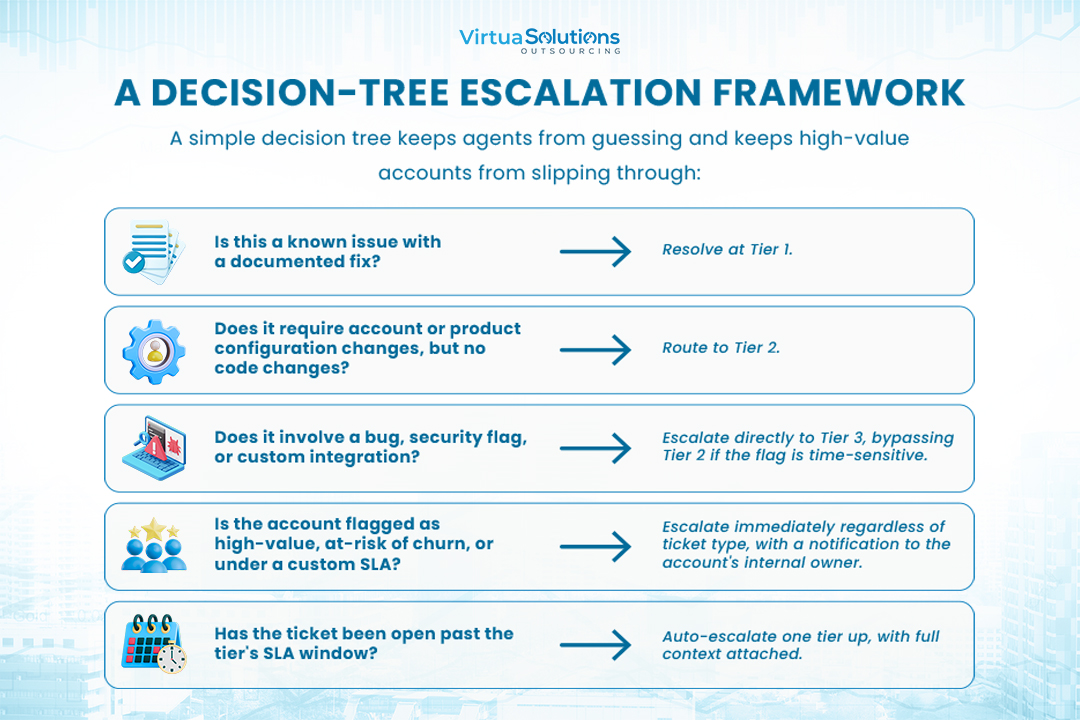
The last two rules matter most. Most escalation frameworks fail not because Tier 1 can’t identify a hard problem — they usually can — but because there’s no automatic trigger for “this account is too important to sit in a queue.”
Tagging high-value accounts in your CRM or helpdesk, and building that tag into your routing rules, closes that gap.
Related: SMS Messaging For Customer Support: A Comprehensive Guide
Making the Partnership Work Long-Term
A tiered model only holds up if the outsourced team is genuinely looped into your product, tools, and escalation triggers — not handed a script and left alone. That means shared access to your knowledge base, regular calibration calls between internal and outsourced leads, and a habit of feeding resolved Tier 2/3 issues back into Tier 1 documentation so the same ticket doesn’t escalate twice.
This is where outsourcing overlaps with other functions. Support rarely operates in isolation — finance teams need billing escalation data, sales and marketing need churn-risk signals, and virtual assistants often handle the admin work that keeps escalation logs current.
For more on building this out, browse our full range of services or check our resources and articles for related reading on outsourced support operations. If you’re curious what a boutique outsourcing setup looks like day-to-day, our BizNest page walks through it.
About Virtua Solutions Outsourcing
We’re a boutique BPO built for SaaS companies and startups that need support to scale without losing its human touch. Rather than a one-size-fits-all model, we shape our teams around what each client actually needs — because collaboration, not just headcount, is what makes outsourcing work.
We see ourselves as an extension of your team, not a vendor at arm’s length, and that’s what keeps our people invested in your growth.
Our team is proudly Filipino, and we’re here to bring that talent onto the global stage where it belongs. And if outsourcing is new to you, which it is for most startups we work with, we’ll walk you through it and recommend what actually fits, not just what’s easiest to sell.
Ready to design a support structure that scales with you?
Book a Free Consultation with our Outsourcing Experts