When a SaaS platform goes down, the clock starts ticking the moment the first customer notices. For a distributed support team spread across time zones, that first moment can also be the most chaotic one — who owns the incident, who talks to the customer, and who fixes the underlying issue?
A well-built customer support function, like the customer service teams that outsourcing partners provide, is what turns that chaos into a coordinated, repeatable response.
Let us help you break down the incident response workflows, escalation paths, and communication templates that keep distributed support teams calm, aligned, and fast when it matters most.
Related: What VCs Want to See in Your Customer Support and Success Operations
Why High-Severity Incidents Break Down in Distributed Teams
High-severity incidents (often labeled SEV-1 or P1) are rare by design, which is exactly why they trip teams up. Most support and engineering staff have never run one before, and without a shared playbook, a distributed team defaults to Slack messages, guesswork, and duplicated effort.
Add multiple time zones — North America, the UK, the EU, and Australia — and you get handoff gaps, unclear ownership, and customers left waiting for updates that never come.
The fix isn’t hiring more people. It’s building a repeatable incident management SaaS support process that any team member, in any time zone, can execute without guesswork.
Related: Overcoming SaaS Customer Service Roadblocks Through Outsourcing
The Real Cost of a Slow Response
The numbers make the case for investing in a proper high-severity support playbook better than any anecdote could:
| • Unplanned IT downtime now costs organizations an average of $14,056 per minute, climbing to $23,750 per minute for large enterprises. (AlertOps, 2024 EMA Research)
• The average downtime cost across industries rose to $8,600 per minute in 2025, up from $5,600 in 2022, and businesses lose an estimated $1.5 trillion annually to downtime and service disruptions. (Cloud Downtime Statistics, DataStackHub)
• Outages lasting more than one hour result in a 7% average revenue loss for affected e-commerce and SaaS platforms, and 58% of organizations reported at least one major cloud outage in the past 12 months. (Cloud Downtime Statistics, DataStackHub)
• High-performing teams resolve critical incidents in under 60 minutes, compared to an industry average of 3 to 5 hours — and cutting MTTR from 4 hours to 1 hour can save an organization roughly $3 million a year. (TaskCall, Incident Management Best Practices)
• Teams with full-stack observability experience outages that cost roughly half as much as those without it — about $1 million per hour versus $2 million per hour for high-impact outages. (IT Downtime Cost Statistics, Virima)
The pattern across every study is the same: the businesses that suffer least aren’t the ones with zero incidents, they’re the ones with the clearest process for handling them. |
Building the Playbook: A Distributed Support Team Process
A strong distributed support team process doesn’t need to be complicated. It needs to be clear enough that anyone on shift, in any region, can pick it up and run with it. Here’s a framework that works well for growing SaaS teams:
✅ Define severity levels in advance.
Agree on what qualifies as SEV-1 (full outage, data loss risk, security breach) versus SEV-2 or SEV-3 (partial degradation, cosmetic bugs). This single decision removes most of the debate during an actual incident.
✅ Assign a clear Incident Commander.
One person owns the incident end-to-end, regardless of who is online. This role coordinates, not necessarily fixes — their job is to keep communication flowing and decisions moving.
✅ Build a 24-hour coverage map.
Distributed teams across the Philippines, North America, the UK, the EU, and Australia can actually be an advantage here — with the right handoff protocol, someone is always awake to pick up the next update.
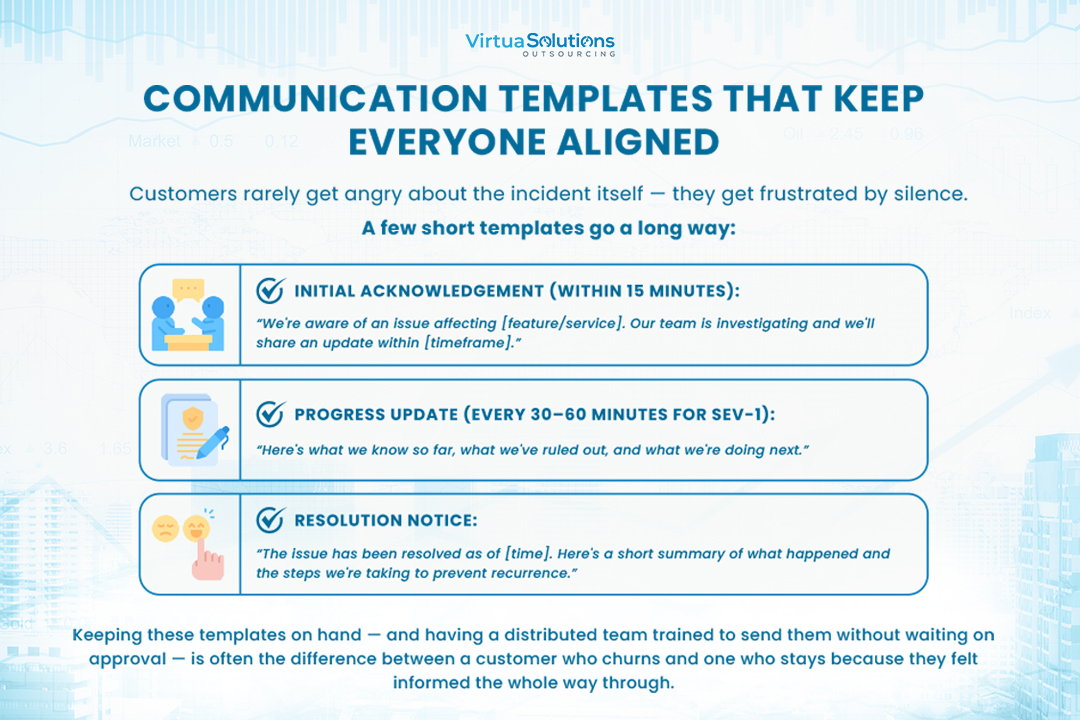
✅ Use pre-written communication templates.
Don’t draft a customer update from scratch mid-crisis. Have templates ready for initial acknowledgment, progress updates, and resolution notices.
✅ Run a blameless post-mortem.
After the fire is out, document what happened, why, and what changes in the runbook next time. This is where MTTR actually starts to drop over time.
Related: Brand Love: The Secrets To Making Customers Fall For You MORE
Turning Distributed Teams Into an Advantage, Not a Risk
A distributed team is only a liability when there’s no shared playbook. With one in place, time zone spread becomes round-the-clock coverage instead of round-the-clock confusion.
This is true whether the incident touches customer service, finance operations, sales and marketing systems, or general virtual assistance support — the same principles of clear ownership, defined severity, and honest communication apply across every function of a growing SaaS business.
If you’re building out your own incident response process, our resources hub and articles cover more practical frameworks for scaling support operations, and BizNest is a good next stop if you’re exploring how outsourced teams fit into a broader operations strategy.
About Virtua Solutions Outsourcing
Virtua Solutions Outsourcing is a boutique BPO built around one idea: we work with what you actually need, not a rigid package. We act as an extension of your team, because we believe that’s what makes outsourced support genuinely invested in your growth — collaboration is our love language.
As more SaaS teams lean on AI tools, we see our role clearly: AI still needs a human to prompt it, audit it, and make the judgment calls that keep customers happy during a high-severity incident. We work with AI, but nothing replaces a person overseeing the work.
Our teams are built on Filipino talent, and we’re proud to bring that talent to the global stage for startups across North America, Australia, New Zealand, the UK, and the EU.
If you’re new to outsourcing, which most startups are, we won’t just hand you a team and walk away. We’ll hold your hand, recommend best practices, and help you build the processes — like your own high-severity incident playbook — that set your support function up to last.
Related Resources: